Introduction
Most teams do not choose between manual and automated follow-up because of strategy. They choose based on habit.
Manual follow-up feels personal. Automation feels scalable. In reality, high-performing teams use both, but with clear boundaries.
This article compares both models in real estate operations so you can decide where manual execution should remain and where automation should take over.
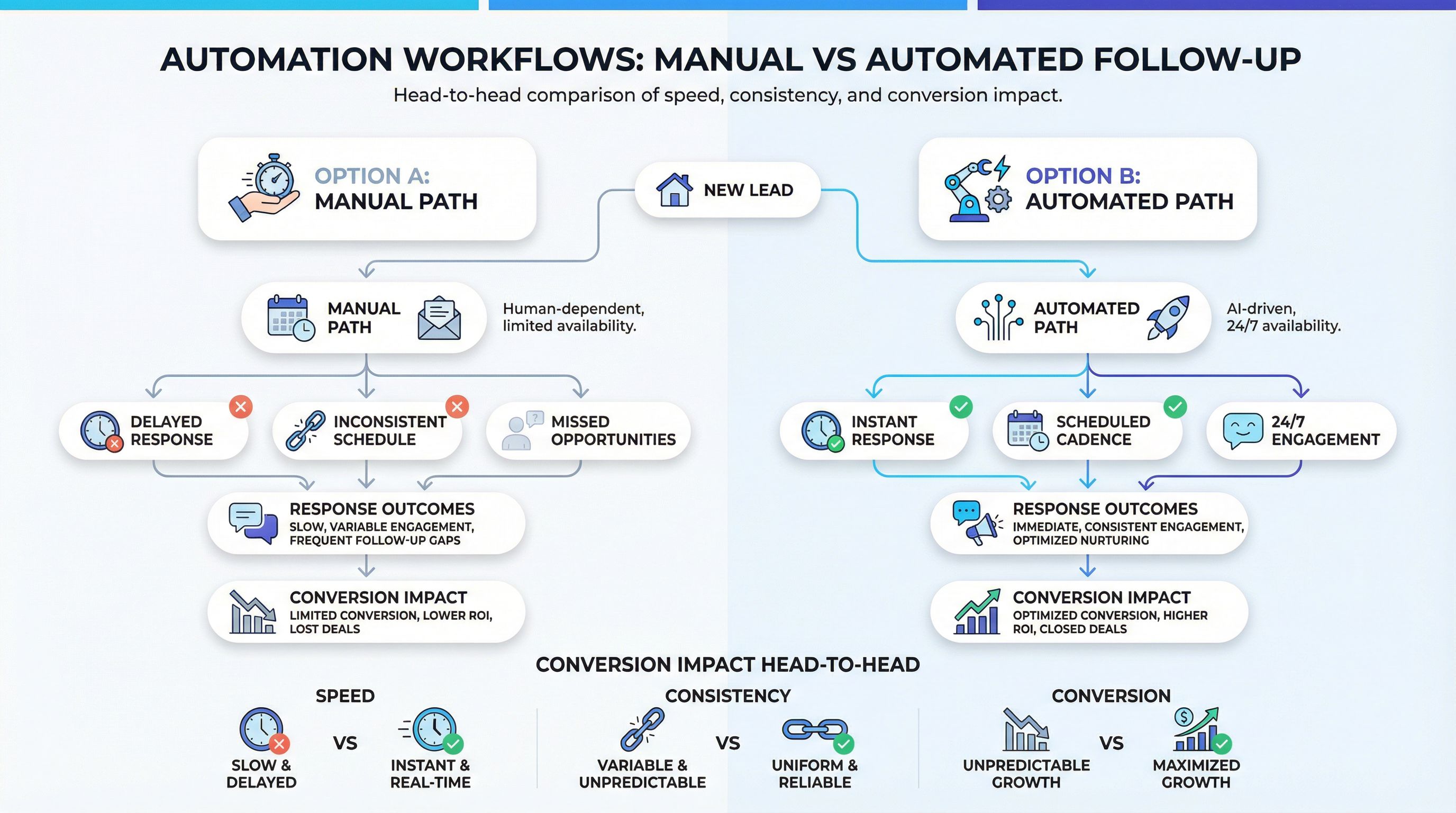
Definitions (Simple and Practical)
Manual Follow-Up
Agent or ISA performs all actions by hand:
- sending first text/email
- setting reminders
- logging activity
- deciding next touch timing
Automated Follow-Up
A system executes predefined actions:
- instant first-touch message
- task creation and reminders
- behavior-based branching
- stage movement and reporting
Automation does not remove agents. It removes delayed and inconsistent execution.
Side-by-Side Comparison
| Factor | Manual Follow-Up | Automated Follow-Up |
|---|---|---|
| Speed-to-lead | Highly variable | Consistent (minutes) |
| Consistency | Depends on discipline | Rule-based and repeatable |
| Personalization | High in live messages | High if templates are segmented |
| Scalability | Limited by team bandwidth | Scales with volume |
| Reporting quality | Often incomplete | Strong if tracked in CRM |
| Error risk | High under workload | Lower, but depends on setup quality |
| Cost profile | Lower software, higher labor | Higher setup, lower marginal effort |
Where Manual Follow-Up Wins
Manual is stronger when judgment matters most.
Use manual-first for:
- live objection handling
- negotiation-sensitive conversations
- nuanced motivation discovery
- high-value relationship moments
Manual communication is best at context interpretation and emotional calibration.
Where Automation Wins
Automation is stronger when speed and consistency matter.
Use automation-first for:
- immediate acknowledgment after inquiry
- standard early qualification touches
- no-response follow-up cadence
- task escalation and owner accountability
- stage updates and SLA alerts
If your team misses leads due to response lag, automation is usually the fastest fix.
The Real Conversion Question
The right question is not “manual or automated?”
The right question is: which steps should be automated and which should remain human-owned?
A practical split:
- automate timing, routing, reminders, and first-touch framework
- keep discovery calls, strategy guidance, and negotiation human-led
Teams that automate everything sound robotic. Teams that automate nothing respond too slowly.
Cost and Resource Tradeoffs
Manual-Heavy Model
Pros:
- no complex setup
- full script flexibility
Cons:
- high labor dependency
- inconsistent performance between agents
- difficult to scale lead volume
Automation-Heavy Model
Pros:
- predictable execution
- better attribution and data
- easier workload management
Cons:
- setup and maintenance effort
- bad automation design can damage trust
For most teams, automation is cheaper over time once lead volume increases beyond what one person can reliably handle.
Common Failure Modes
Manual Model Failure
- follow-up happens too late
- tasks are not logged
- no clear ownership after initial touch
Automation Model Failure
- generic templates with low relevance
- no stop rules when lead replies
- no clear handoff to agent
Both models fail when process design is weak.
Decision Framework: Which Model Fits You Now?
Choose Manual-First If:
- lead volume is low and stable
- team is small and highly disciplined
- you can consistently respond within minutes
Choose Automation-First If:
- lead volume is growing or inconsistent
- response-time performance is slipping
- multiple people touch the same pipeline
- reporting and accountability are weak
Choose Hybrid (Recommended for Most Teams) If:
- you need both speed and strong relationship quality
- you want predictable operations without robotic communication
Recommended Hybrid Operating Model
- Automate first response within 1-3 minutes.
- Automate qualification touches for non-responsive leads.
- Trigger human handoff on reply, click, or score threshold.
- Automate reminders and escalation if tasks are missed.
- Keep high-impact conversations manual (calls, consultations, objections).
This model usually outperforms pure manual and pure automated extremes.
KPI Benchmarks to Compare Your Current State
Track before and after:
- median speed-to-lead
- first reply rate
- qualification rate
- consultation booking rate
- conversion to active client
If automation does not improve these metrics, fix the workflow design, not just the copy.
Frequently Asked Questions
Is automated lead follow-up better than manual follow-up for realtors?
Usually, no single model wins in every stage. Most teams perform better with hybrid execution.
Will automation make follow-up messages feel robotic?
Not when segmentation, personalization fields, and stop rules are configured correctly.
What should be automated first?
Start with speed-to-lead, reminders, and repeatable early-stage touches.
When should follow-up remain manual?
Keep discovery, objection handling, and high-stakes decision conversations human-led.
Final Recommendation
For most real estate teams in growth mode, the best answer is a hybrid model:
- automate predictable operational steps
- protect human ownership where trust and judgment drive conversion
That gives you speed without losing quality.
If you want a custom decision map for your team, schedule a consulting call and we can assess your current process against this model.